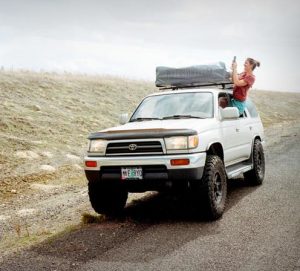


Sure, there is more to know… but no more, you need to know. A well-selected and maintained set of tires can contribute greatly to your safety, increased fuel economy, better handling, and stopping in all road conditions as well as provide greater comfort and ride quality. Wow, that sounds like the entire car… indeed, tires are important. Upgrading your tires is another topic all together, let’s talk replacement for now.
I recently had a customer ask me about upgrading the tires on her Jeep. I had some straightforward answers that made sense to her so I thought I’d share some of these basic points with my readers.
First, Do You Really Need New Tires?
 Before taking the plunge on a new set of all terrains, perform a quick visual inspection. If you see cracked sidewalls, discoloration, dents, bulging or excessive tread wear, it’s probably time for a new set. A simple way to check the tread on your tires is the old penny test. It’s not terribly scientific but its all you need to know for your initial assessment.
If your tires are more than 10 years old, consider replacing them even if they look fine. Rubber deteriorates with exposure to oxygen (beware of tires that have been in storage for long periods). In my customer’s case, the tires on her Jeep were over ten years old and had less than 2000 miles on them. I urged her to replace them anyway.
Is Your Car the Culprit?
If your tires are looking sketchy and you’re confident that a fresh set is needed, it’s time to take the next step. Use the checklist below to eliminate your car as the culprit. The way your tires wear can reveal suspension problems instantly, check them out for possible signs.
1. UNEVEN TREAD WEAR INDICATES POOR WHEEL ALIGNMENT.
2. EXCESSIVE WEAR ON ONE SIDE OF THE TIRE SIGNALS INCORRECT CAMBER ANGLE.
3. IF THE TREADS ON THE OUTER SECTION BECOME KNOBBY, IT MAY SIGNAL PROBLEMS WITH THE TOE-IN VALUE.
4. EXCESSIVE WEAR IN CENTER TREAD INDICATES OVER INFLATION OF THE TIRE.
5. EXCESSIVE WEAR ON SHOULDERS MAY SIGNAL PROBLEMS SUCH AS UNDER INFLATION OF THE TIRE.
Choosing The Correct Tires
OK, if it is going to happen and new tires are definitely in your future then make sure you select the right tires. The best replacements will be original equipment (the tires that a vehicle was originally equipped with from the factory) or at least the same type and size, the brand is more of a personal preference. That mysterious string of numbers, letters, and punctuation on your tire’s sidewall is its identification code. It should look something like this, P215/65R 15 95H M+S. A good tire center will quickly reference this code and cross-reference all possible replacements for you. For my more inquisitive readers however, check out the cipher explanation below, courtesy of CNN’s 10 great tips for buying tires article… it’s all you need to know.
CODE

The manufacturer of your car will most likely recommend that you replace your tires with the original type and size. This is to ensure that your tires have a maximum tread life, handle properly, and keep you safe. My recommendation is to replace all of your tires at the same time with a matching set. Your tires will function better, be easier to maintain, and any future suspension issues will be easier to recognize and repair.
Tire Upgrade Time?
Original equipment tires are all you need unless you’re changing the way you use your vehicle. For example, if you’re planning to pull a trailer, you may need more load capacity or wider tires with less vehicle roll. Upgrading or changing tire sizes can provide several advantages:
1. Enhanced traction on acceleration
2. More grip on hard braking
3. Less vehicle roll in corners
There are also disadvantages to changing the size of your tires:
1. You can hydroplane much easier or lose control on slippery or loose surfaces like gravel with wider tires
2. The wider tires may not fit inside your wheel wells
3. Your turning radius can be dramatically reduced as wider tires contact the bump stops sooner
4. Wider tires can be quite costly to install
5. Increased road noise
A Good Tire Center
A qualified tire center representative will be able to explain your tire’s codes and will know which tires are a good fit for your vehicle. Typically, your choices will be summer, all-season or winter tires with extended tread life and better handling options. I recommend taking your sweet time and get as much information as you need to make a confident, well-informed decision. The average cost to replace your set of tires runs from $450.00 for standard, all season radials to $1000.00 and up for your truck or SUV. Choose wisely shoppers!
Have questions? Call or text (757) 560-4252 and ask for Mike Love.

Sources:
Fogelson, Jason.“10 great tips for buying tires” CNN.COM 7/16/2008. Web. Retrieved from: http://www.cnn.com/2008/LIVING/wayoflife/07/16/aa.buying.tires/index.html
“How to tell if you need new tires” FIRESTONECOMPLETEAUTOCARE.COM 2019. Web. Retrieved from: https://www.firestonecompleteautocare.com/penny-tire-test/
Unrau, Jason “Are Wider Tires Better” YOURMECHANIC.COM 11/12/2015. Web. Retrieved from:https://www.yourmechanic.com/article/are-wider-tires-better


 With the exception of an occasional cold day, the end of winter is in sight and the sun is finally peeking through the clouds! We’ve had a long, cold winter and now we can all look forward to hanging up our coats and unpacking our tees! This change in the weather brings big changes in our lifestyles too. More time outside, exercise, fresh air, and lots more fun are on tap for the coming months!
 Of course, comfort means different things to different people. When you’re looking for a new vehicle, it’s important to keep your specific needs in mind. For example, if you’re headed across state lines with four kids and a dog in tow, your first concern is space and durability. Are you looking for an SUV or a minivan? Would you prefer easy to clean leather seats? Then again, if your family goes all out on decorations, you might consider something with room to store your lights, trees, and figurines, like a pickup truck. But what if you’re looking forward to a romantic holiday of two? Something smaller and sportier might suit your needs. You can keep costs down on your get-away by going for a fuel-efficient option, too.